identification
Identification help
The following resources will help you identify some of the common British plants and animals.
Plants and fungi
Hedgerow plants
An illustrated guide to common hedgerow plants.
Part of the OPAL biodiversity survey.
Duckweeds
You'll find duckweeds floating on the surface of many ponds and lakes. Discover the six most common species.
Part of the OPAL water survey.
Seaweeds
A guide to the common seaweeds you can find on the British coast.
Part of the Big Seaweed Search.
Lichens
A simple guide to nine common lichens. Part of the OPAL air survey.
Minibeasts
Dragonflies and damselflies
A guide to the most common dragonflies and damselflies.
Part of the OPAL water survey.
Earthworms
A simple illustrated key to nine common British earthworms.
Part of the soil and earthworm survey.
Aquatic invertebrates
Water boatman or water beetle? Get to know the common aquatic invertebrates that may be living in your pond.
Part of the OPAL water survey.
Moths
Tips on how to trap moths and useful tools available to identify them.
A photographic guide to the families and common species of British moths.
Common invertebrates
Other
Amphibians
Know your frogs from your toads with this guide to common amphibians.
Part of the OPAL water survey.
Discover classification - teacher pack
Aimed at Key Stage 3, this resource pack includes lesson plans to support the teaching of biological classification.
Still struggling? Identify anything and everything with help from these online communities
A bird that sounds like rocks, and more...
Last Wednesday it felt more like December than May, but a group of 10 people braved the icy wind and we went for a walk along the Pocklington Canal, East Yorkshire, for an OPAL course called "Look Listen and Learn". This course was led by bird expert John Wint from the Yorkshire Naturalists Union and he made sure that we did lots of listening, looking and learning. My favourite part of the course was hearing a sedge warbler. The sedge warbler call sounds like someone grinding two stones together! Have a listen on the RSPB site and let me know if you agree!
And here's a picture of one, taken from the Encyclopaedia of Life. Quite a drab looking bird compared to its song.

Other highlights were a noisy curlew mobbing a marsh harrier over nearby Wheldrake Ings.
At first, the warblers all sounded very similar to my ears, but by the end of the walk I could tell the difference between a couple of them. What I need now is some more practice. And more sunshine next time, please.
- OPAL Yorkshire and the Humber
- Login or register to post comments
Ever wanted to know what type of moth, snail, plant, bird, insect....that is?
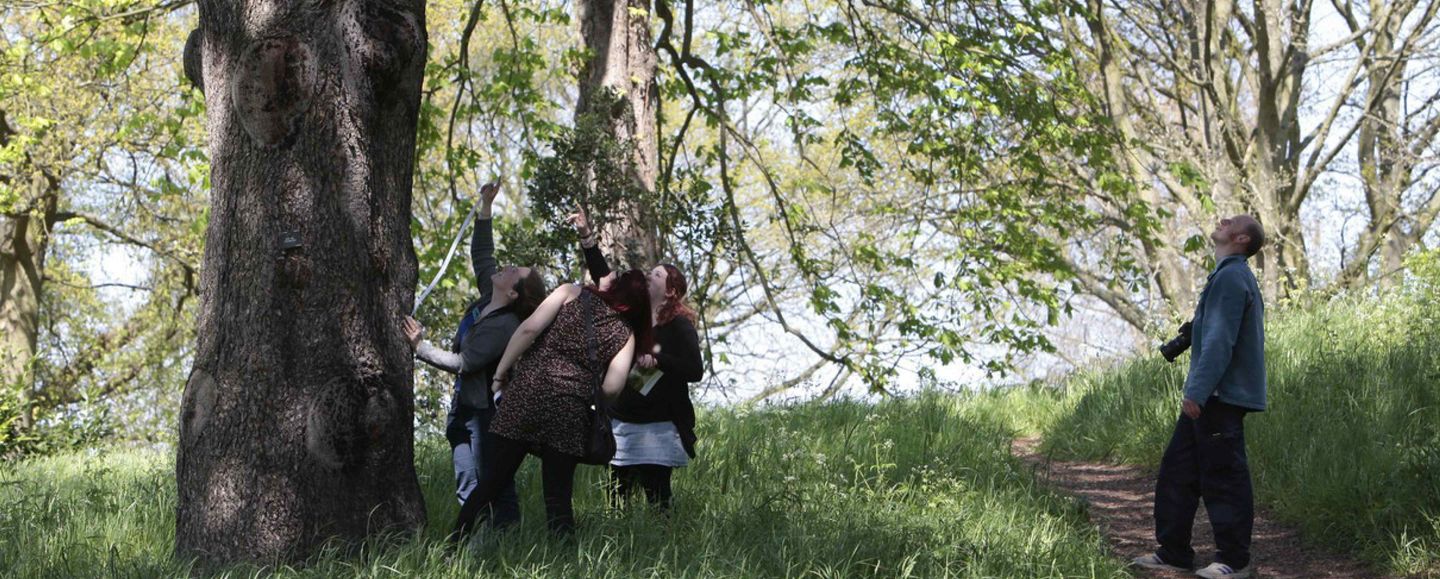
Hopefully the training courses I'm organising at venues across Yorkshire and the Humber this summer will help you to identify the plants and animals that live in your local area. The courses are most suited to beginners, i.e. people who have had little or no experience identifying species.
At the moment I'm busy organising venues and finding tutors, who all give up their time for free to help teach others about the things they are passionate about. The courses usually involve a bit of indoor learning and a field trip, this photo was taken at the beautiful Skipwith Common near York on the Fungi ID course last year, run by Alan Braddock of the Mid Yorkshire Fungus Group
To find out details of the courses we're running this year, go to the Yorkshire and Humber OPAL pages which gives details of all our upcoming events. Then email or phone me to book your place as soon as possible, as these courses are very popular!
- OPAL Yorkshire and the Humber
- Login or register to post comments
Learn to identify moths on a free training course

Take part in a moth identification training course this year and learn from the experts how to trap and identify some of the fascinating moths living in the UK.
There are more than 2,000 species of moth in this country, ranging from the colourful and distinctive Cinnabar moth to the well-camouflaged Eyed Hawk-moth. Explore this staggering diversity and learn the skills you need to identify moths accurately.
The courses wil take place in the West Midlands region and are completely free. They are aimed at beginners and intermediates. There are five one-day courses, beginning on Sunday 23 May 2010. You can come to one or all five. Those who attend all the courses will go away with a strong grounding in moth identification and will be able to trap and identify moths on any site unaided.
Places on these courses are limited, so we recommend you book your spot now to avoid disappointment.

See the West Midlands activity page for information on upcoming events and how to register.
Download the timetable for details of all the moth identification training courses scheduled for this year.
The training courses are sponsored by OPAL, Butterfly Conservation West Midlands and the Field Studies Council.
Explore wildlife with The Darwin Guide
Learn to discover wildlife just like Charles Darwin. A free guide produced by the National Biodiversity Network (NBN) helps you follow in his footsteps.
In celebration of Darwin’s bicentenary and the 150th anniversary of the publication of The Origin of Species, the NBN has produced The Darwin Guide to Recording Wildlife.
Co-authored by Randal Keynes, great-great-grandson of Charles Darwin, the guide offers a fantastic insight into how Darwin observed wildlife. It also explains ways you can get involved, what to look for and the basics of how to record.
The Darwin Guide to Recording Wildlife is completely free. It has been funded by the Department for Environment, Food and Rural Affairs (Defra) and is aimed at anyone with an interest in nature, whatever their age.
You can download your copy from the NBN website, or if you prefer you can order a hard copy.
Natural History Museum
Bugs Count survey, exhibitions, and help for local natural history groups
The OPAL team at the Natural History History Museum does everything from organising events to developing ID guides and supporting natural history societies. The team also developed the Bugs Count survey.
Find out more about the Museum's work in the gallery below:
The Museum Projects
1. OPAL Exhibitions and community led celebrations
j.tweddle@nhm.ac.uk
OPAL organises themed exhibitions, demonstrations, training workshops, talks and other community events. A range of publicity materials display OPAL’s achievements, including a temporary exhibit within the Natural History Museum.
2. OPAL Bio-buses
j.tweddle@nhm.ac.uk
The Museum has provided a fleet of OPAL branded, low-emission vehicles so that scientists and groups taking part in OPAL projects can travel throughout their region. These vehicles will improve access to our study locations, especially for people and communities who would otherwise find it difficult to get there.
3. Supporting amateur natural history societies
lucy.carter@nhm.ac.uk
One of OPAL's key objectives is to support amateur naturalists and voluntary groups, and help more members of the public become aware of them. We are offering expertise and funding and building a countrwide network of societies.
4. The Naming of Things: OPAL Taxonomic Support Programme
lucy.carter@nhm.ac.uk
OPAL aims to open up the richness of UK biodiversity to a wider range of people, and promote a greater interest in natural history. As part of this project we are developing online and printed guides about UK plants, animals and environments - and how and why scientists study them. We are also putting local groups in touch with experts who can assist with identification where needed.
5. OPAL website
c.howard@nhm.ac.uk
The OPAL website reports news and gives details of activities from all OPAL partners. Results are collected for the six national surveys on the website and displayed in real time. The site also points to online resources and local societies so you can develop your interest in nature even further.
6. OPAL Communications Office
media@opalexplorenature.org
The Communications Office aims to raise the profile of OPAL through the planning and implementation of a comprehensive communications strategy. A Communications Officer acts as a mentor for partners so they are able to make the most of media opportunities in their area. The Officer is also responsible for developing and managing the OPAL brand.
OPAL Biodiversity Centre
Discover the fascinating plants and animals that live near you

The OPAL Biodiversity Centre hopes to inspire people of all ages to take an active interest in England's diverse range of wildlife.
Led by the Open University (OU), the centre is developing new resources to help identify and study nature. It is also coordinating the OPAL biodiversity survey, which begins in September 2010.
Bayesian keys
A range of Bayesian keys are being developed to make species identification easier, more reliable and more fun for new observers. These keys will also be made available on mobile phones.
What are Bayesian keys?
Instead of leading you through a set path of questions, Bayesian keys allow you to enter as much detail as you can into a computer program. The program then works out a list of possible matches and presents them in order of likelihood. Such keys are particularly helpful for beginners, as they allow for small and sometimes inevitable identification mistakes.
Neighbourhood Nature course
Take your interest in nature further by studying a Neighbourhood Nature course. Learn how to study, record and identify local wildlife.This new Open University course is available to all and credits can be used towards an Open University degree.
iSpot
iSpot is an online nature community where you can share your discoveries in the natural world.
iSpot Biodiversity Mentors
Regional mentors across England are helping local wildlife enthusiasts share their observations and knowledge on the iSpot website.
Policy and regulations
If you are interested in learning more about government policy on biodiversity then please visit:
Contact us
j [dot] ansine [at] open [dot] ac [dot] uk

Join in the biodiversity survey
Contribute to important research and discover the incredible diversity of life that hedges support.
Hedge conservation
Learn more about the management and conservation of hedges and why it is so important.