Bugs Count


trees

Activity 3 - Goodbye old tree

What should be done with the old tree?

Hazel Nutt needs your help in deciding what to do with the Treedwell tree that was chopped down. There are many useful ways we can use trees. Some ideas are listed below. Can you think of any more?

Send Hazel your ideas and photos, and we'll display the best on this page.

Email them to opal@imperial.ac.uk or post to: FREEPOST RSCH-CHYJ-HYYC, OPAL, Centre for Environmental Policy, Imperial College, South Kensington, London SW7 2AZ.

Ideas on how to make use of the tree

You need to download the latest Flash Player to view this video. Visit the website to download the Flash Player

Invertebrate expert Roger Key takes a look at the life in rotting wood

Create a home for wildlife
Encourage wildlife into your garden or school grounds by building a bat box, bird box or bee hotel, using the wood from the tree. You can also make a wood pile to attract invertebrates and hibernating hedgehogs.


Leave the tree to rot
This may sound like a lazy and wasteful thing to do, but rotting wood is an important habitat for many creatures.

Why not leave some of the tree and see which animals colonise it over time? Look out for woodlice, beetles, millipedes and other invertebrates.


Create works of art
Many artists use the wood from trees to make sculptures, or the leaves to make interesting pictures. Why not have a go at creating a work of art with the leaves and twigs from trees? Take a look at the work of Andy Goldsworthy for inspiration - www.morning-earth.org/artistnaturalists/an_goldsworthy.html.

A gallery of ideas on how to make use of an old tree. What others can you think of?


Activity 2 – A special new tree

What's the best tree to plant for the residents of Treedwell?

It is up to you to decide which tree to plant in Treedwell for future generations to enjoy. There are many trees you could choose, but which one will you decide on and why?

Some trees produce beautiful flowers, and some will be preferred by certain types of wildlife. They also vary greatly in size. You may want to start by getting familiar with common British trees.

ACTIVITY - How many different types of tree can you find near you?

Get to know the common British trees

OPAL tree guide (PDF) - an illustrated guide to the leaves, twigs and fruits of common British trees
Tree gallery - photos of British trees with their distinguishing features
Tree identification key - an interactive key on the Natural History Museum website

What do other people think?

Asking other people for their opinion will also help you decide which tree to choose. Here's what people in the OPAL team have to say. You can use these responses as part of your investigation. What do your friends and family think?


Roger

"I like Silver Birch trees because they have shiny bark."


Laura

"Ash trees are my favourite because they produce lots of seeds, and birds like to nest in the one in my garden."


Simon

"Sycamore. Their winged seeds spinning away like tiny helicopters always stop me in my tracks to watch and wonder about evolution and the natural world."


Helene

"My favourite tree is the Beech. I love the way the colours of the leaves change through the seasons."


My favourite tree - Read more opinions on the British Trees website


Join in the OPAL earthworm survey

Look for earthworms and help scientists with valuable research.


Join in the OPAL air survey

Investigate lichens on trees and find out about local air pollution.


Activity 1 - Tree Trouble

Should you save Treedwell's tree?

The mayor of Treedwell is keen to cut an old tree down to make room for more housing. Do you think the tree should be chopped down, or do you sympathise with the protestors?

In order to decide, you'll need to think about how important the tree is. If it  is chopped down, will it just be the tree that is affected?

How can you investigate the importance of trees?

Look for signs of wildlife
Trees are important habitats for a variety of animals. What can you see living on your tree? Are there any bird nests? Can you see any of the common invertebrates described in the guide below?

Look at the ground around the tree. Do you see any burrows or holes? What animals do you think could be living in those holes? Try searching on the internet to find out.


Discover lichens
Are there any lichens living on your tree? Many varieties grow on the bark of trees but they are often overlooked. What kinds of lichens have you discovered?

OPAL lichen guide (PDF, 2.2MB)
Online lichen guide - a simple photographic guide to common British lichens


How old is your tree?

Find out a simple way to estimate the age of a tree.


Further activities

Listen to a tree
Listen to a tree by holding a microphone to the trunk and recording the sounds. When you play it back what do you hear? What do you think is making the sounds?

Urban tree survey
Join in a nationwide survey of British trees organised by the Natural History Museum.


Join in the biodiversity survey

Contribute to important research and discover the incredible diversity of life that hedges support.


Join in the OPAL air survey

Investigate lichens on trees and find out about local air pollution.


Why do some trees go yellow and some go red in autumn?

28 October 2010

I was pondering this question as I looked outside my office window...

Yellow and red trees

So, thanks to the wonders of the internet, I have now found answers to this question! The yellow and orange colours in leaves at this time of year are caused by pigments in the leaves that are there throughout the year. The rest of the year though, the colours are hidden by the green of the chlorophyll in the leaves - this is the stuff that trees need to make food for themselves by the process of photosynthesis.

The beautiful red colours that you see in some species of cherry and acers etc is caused by pigments called anthocyanins - these are only present in the leaf once the green colour (chlorophyll) has started to break down. Anthocyanins are thought to act as sunscreens, as they filter out the UV elements of sunlight, protecting the leaf from light energy that earlier in the year would have been absorbed by the chlorophyll.

However, like so often in science, this has ended up being a very complicated question, and there is still much research that needs to be done to answer it! The Leaf Color Bibliography website gives links to some detailed research if you have the time to read it...

Spring cherry blossom

22 April 2010

Wow, what lovely weather we've been having the past few days - and it's due to get warmer over the weekend.  If you're looking for an outdoor activity and can't wait for the OPAL Water Survey to start in two weeks time, how about giving the Natural History Museum's cherry tree survey a try? Cherry trees are so easy to spot at ths time of year as they are in full blossom. Find out more on the museum's website.

The sunshine will also be bringing lots of butterflies out, and I'll be out looking for them as I've signed up to record butterflies in my little patch of Sussex. A couple of weeks ago I went to a conference funded through the OPAL Grants Scheme where lots of butterfly recorders got together to kick-start the process of creating a new butterfly atlas for Sussex (a book of maps and photos that details where all the different species can be found in the county). I really enjoyed the conference and was impressed at the turnout and the enthusiasm of the Butterfly Conservation Sussex recorders. As a result I've been inspired to give it a go in my local area!  Will keep you posted with my progress.  I saw a Holly Blue last weekend, but unfortunately didn't have my camera with me so can't share a photo with you.  Will post some piccies as and when I get them.

Unfortunately I'm not spending as much time outdoors as I'd like because we're really busy at work.  The OPAL Grants Scheme closes to applications in the next 2 weeks so I'm busy answering enquiries and sorting out all the paperwork.  We also have two BioBlitzes (24 hour wildlife survey events) coming up at the start of June so we're busy booking marquees and generators, inviting local naturalists, recruiting volunteers, and designing activity sheets and displays. Busy busy, but good fun too!

Battling on in spite of the snow...

12 January 2010

How many of you have had a day off work or school because of the snow? Lots I bet. We also got a day off last Wednesday, but other than that have been battling on regardless!  Last Thursday to Saturday we held a stand at the Association for Science Education conference in Nottingham.  It was a bit of a struggle getting up there (about 6 hours on the train!), but we spread the word amongst lots of teachers about our new lesson plans that we've developed as part of the OPAL Taxonomy project - another aspect of my job at the museum. Taxonomy is the science of naming and classifying living things and is really important to every aspect of biology.  You can't study a particular organism if you dont know what it's called and what makes it different from other similar organisms.

Classification is now part of the Key Stage 3 school curriculum, so we've made a set of three lesson plans for teachers, to help them teach classification in a fun way (which involves eating yummy foods!). You can download the lesson plans here.

We were also telling the teachers all about the OPAL national surveys, especially the Water Survey which is coming up this Spring.  If your school hasn't taken part in any surveys yet, point the teachers towards this website!

So what did I do on my snow day off last Wednesday? I went for a lovely walk in the woods near where I live and saw this big old oak tree. My local wildlife group Horsham Natural History Society had just held a talk about the Woodland Trust's Ancient Tree Hunt the week before. They are trying to map all the really old trees in the country because they are so important for wildlife.

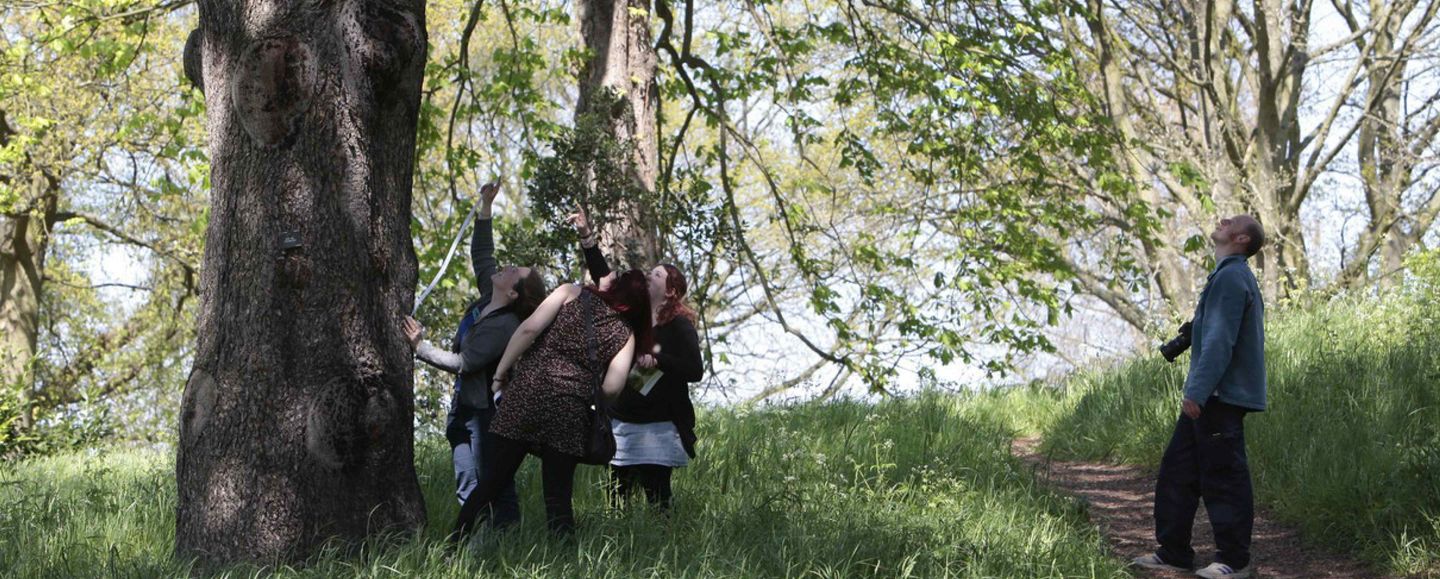
To test if a tree is classed as 'ancient' you have to give it a hug (see photo of me hugging the oak tree!). If an oak is more than 3 hugs round it's probably an ancient tree.  Do you know of any big trees near you?  If you do, go out and give them a hug! Here's what you are looking for - the number of hugs needed for it to be ancient varies between species:

Oak – 3 adult hugs
Beech – 2 adult hugs
Birch – a wrist hug
Hawthorn – an elbow hug
Field Maple - 1 adult hug
Sweet Chestnut - 4 adult hugs
Ash - 2 adult hugs

I'll have to save my tree hugging for weekends now though, as I'm back in work as usual even though the snow hasn't really melted.  More snow due tonight though - maybe I'll get another snow day...

South West - local nature and wildlife activities

Explore the diversity of nature in the South West

From Exmoor and Dartmoor National Park to the beautiful Cornish and Dorset coasts, there is a rich variety of habitats and wildlife to be seen in the South West.

There are also numerous woodlands and parks in our cities that are filled with interesting and important wildlife.

Discover your local environment with OPAL

Take part in an OPAL survey
Learn more about soils, water, lichens and climate, and contribute to valuable research with our OPAL surveys.

For support, advice and survey packs contact alison.smith@plymouth.ac.uk.

Join in an OPAL event or activity
From identification workshops to fun family days out, we run a range of activities that you can get involved in. Get in touch to find out more.

Tailored activities for your group or school
We can organise an event specifically for your group.

Event photos

See photos from previous OPAL events.


Previous events include survey days, pond dipping, nature trails and minibeast hunts. Contact alison.smith@plymouth.ac.uk.

Help with one of our research projects

Grassland surveys
We need your help to investigate species diversity in grassland habitats. No previous experience is required and you'll learn basic survey and identification skills.

Botanical teaching methods
We're running free plant identification workshops across the region. We'll be using different teaching methods for each plant group to assess which method is the most successful for botanical teaching.

If you are interested in taking part in a grassland survey or ID workshop, contact alison.smith@plymouth.ac.uk.


Enter our Plymouth Wildlife and Nature Photography Competition

We're looking for budding photographers of all ages to send in their favourite wildlife photos taken in Plymouth. Winners will receive a high quality canvas print and their photo will be displayed at a Plymouth University exhibition.


Watch the OPAL South West team in action and find out about the scope of their work


Upcoming events

Tue 14 February - OPAL Explore Nature sessions, Woodland Wood, Honicknowle (off Ringmore Way), 12.00-16.00
Discover wildlife in your local woods and take part in the Plymouth Wildlife and Nature Photo Competition.

Wed 15 February - OPAL Explore Nature sessions, Ham Woods, Ham (off Tewkesbury Close), 12.00-16.00
Discover wildlife in your local woods and take part in the Plymouth Wildlife and Nature Photo Competition.

Thurs 16 February - OPAL Explore Nature sessions, Southway Valley Local Nature Reserve (off Pendeen Crescent), 12.00-16.00
Discover wildlife in your local woods and take part in the Plymouth Wildlife and Nature Photo Competition.

Sat 3 March - Plymouth Insect Film Festival, Plymouth University, Roland Levinsky Building, open 11.00, last film 20.30
Includes talks, films and interactive displays.
 

Research results - Restoring woodland in Dartmoor National Park

OPAL has worked with conservation group, Moor Trees to study the habitat and ground flora of newly planted woodlands. Learn more in our summary report (PDF, 6MB).
 

Contact us
alison.smith@plymouth.ac.uk


OPAL South West is led by the University of Plymouth

South West partners: Bristol Natural History Consortium, BTCV, Devon Bat Group, Diggin’ it, Moor Trees, Plymouth City Council, Plymouth Museum, Tamar Valley AONB